
Lee County Wanted Fugitives
Lee County has no public most-wanted page. There is no fugitive gallery, warrant list, or reward posting from the Sheriff's Office. That absence is worth stating plainly. No verified list URL exists, no count of wanted individuals, no photo display, no archive, and no posting schedule. Pulling names from some other jurisdiction would only mislead readers. And a missing list says nothing either way about whether any particular warrant exists.
Warrant status and custody are two different questions here. The county relies on a regional detention setup, so custody answers live elsewhere. Dated arrest and jail-commit reports from the Sheriff, the Southwest Virginia Regional Jail Authority's current-custody search, and a court docket each cover separate ground. None of them replaces live confirmation from the agency that issued the warrant. Someone may show up in one channel, get released, be transferred, or appear nowhere at all.
Important: Do not approach, follow, detain, photograph, or confront anyone based on an online claim. Call 911 for emergencies, or use the Sheriff's official tip channel otherwise.
Lee Wanted Listing Fields
The Sheriff's Office posts no public wanted list. So there are no Lee County listing fields to show. The table below marks that confirmed gap and separates it from details you might find on a statewide page. It also keeps a generic wanted-list template from sounding like a description of local practice.
| Public-list item | Verified Lee County status |
|---|---|
| Name or identifier | No Sheriff public wanted list located |
| Photograph or description | No Lee list photo policy or display was verified |
| Warrant charge or charge | No local listing-field description was published |
| Reward or Crime Stoppers detail | No reward or Crime Stoppers affiliation was stated |
| Update date or archive | No cadence or historical list was located |
A listing posted by some other agency is still just a request for information. Verify who published it, confirm the person's identity, and check any later case outcome through official channels before relying on it.
Check Lee County Warrants
No verified public warrant-search portal exists for Lee County, and there is no warrant-specific phone line. Wondering about your own status? Contact the issuing court or a lawyer. The Sheriff's Office can be reached at its published non-emergency number. Keep in mind that a clean web search, a news story, or a third-party database result proves nothing about whether a warrant is active.
- Identify the court or agency most likely connected to the matter, using the known county and case details.
- Contact the Lee County Sheriff’s Office at 276-346-7777 for a non-emergency inquiry, or 276-346-7753 for the office.
- For a court-linked question, contact the Lee General District Court clerk at 276-346-7729 or speak with qualified counsel.
- Use the official court tools for filed-case context, while recognizing that a docket is not live warrant confirmation.
The county-wide booking and custody lookup helps separate current regional custody from an older arrest report. It cannot confirm whether a warrant is still active. That limit matters when the answer could shape a safety decision or a legal one. For live warrant status, only the issuing agency can say.
Lee Court Records and Warrants
Virginia's Case Status and Information hub lets you follow a case once it has been filed. Depending on the court and the record, it may show hearings, charges, continuances, pleas, or dismissals. It will not certify that a warrant is current, recalled, or absent.
Lee General District Court holds in-custody and bonded arraignments at 8:30 a.m. on Monday, Wednesday, and Friday. That schedule sketches the local path after an arrest. It guarantees nothing about any single hearing. For how a case ends up resolved, the court record is the place to look.
- Warrant
- A court or judicial authorization that law enforcement may act on under its terms.
- Arraignment
- An early court appearance where charges and procedural rights are addressed.
- Disposition
- The court’s later outcome, such as dismissal, plea, conviction, or another resolution.
Note: A docket entry can add useful context, but only the issuing court or agency can answer whether a warrant stands today.
Lee County Anonymous Tips
Want to report someone on a Lee County wanted list without giving your name? The Sheriff's Office has a dedicated Submit a Tip page built for exactly that. Visitors get two anonymous options there. Fill out the web form, or call the tip line at 276-346-7756. Neither route asks who you are. The office has not published any reward amount, Crime Stoppers arrangement, mugshot lineup, or schedule for updating its fugitive roster, so treat those details as unknown rather than guaranteed.
For a quick reference, the Sheriff's tip portal is the one bookmark worth saving.
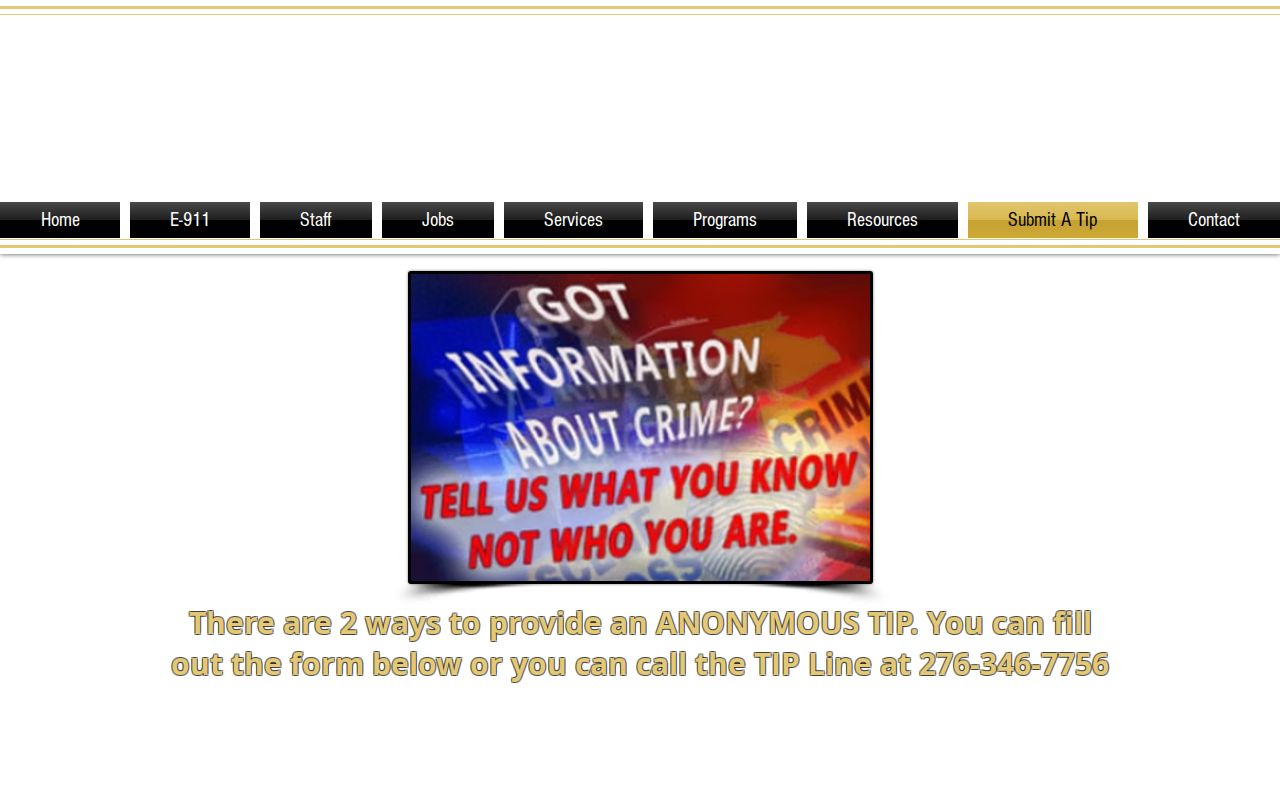
In short, the tip page documents a way to report information. It is not a wanted-person gallery and not a statement that any individual is being sought.
Lee County Sheriff’s Office
Anonymous tip line: 276-346-7756
Non-emergency: 276-346-7777
Office: 276-346-7753
For an emergency: 911
Share what you know and let law enforcement handle the response. If the question is your own possible warrant, court contact or counsel is the right path.
A Sheriff text-alert service exists too. It is an SMS information channel, not a warrant lookup or booking-photo tool. Enrollment messages and public alerts are no substitute for the Sheriff's official answer to a warrant question.
Note: The anonymous tip options exist for reporting information to the Sheriff's Office, not for confirming rumors or seeking a public warrant determination.
Virginia Wanted Lists Are Statewide
Statewide lists operate on a different level than Lee County postings. Two examples matter here: the Virginia State Police Wanted Persons page and the Virginia Department of Corrections Most Wanted page. Neither comes from the Lee County Sheriff. Neither tells you whether someone faces local charges or sits in a local cell.
A name match means little on its own. Copied entries floating around online are worse than useless, so take any possible hit straight to the agency that posted it. Statewide lists also stay silent on local questions. They cannot say whether a person is held at Southwest Virginia Regional Jail Authority's Duffield Facility, has been released, or has a case pending in a Lee County court.
Lee County Text Alerts
The Sheriff's verified public channel is LCSO Text Alerts. To sign up, text LCSO to 276-240-8787. The enrollment page explains the STOP option and how messages get delivered. Think of it as a news feed from the Sheriff's Office. It is not a warrant app, a most-wanted roster, or a booking-photo search.
No verified Lee County Sheriff mobile application exists for warrant status, jail results, or mugshots. An alert naming someone is not confirmation that the person is wanted or in custody either. For a real answer, go to the Sheriff, the court, or the regional jail's live custody search.
Note: Text alerts share county information but cannot replace a live warrant determination by the issuing court or law-enforcement agency.
Lee County Warrant Record Limits
No public system opens every door. Lee County publishes no local warrant portal, and the Virginia court index has its own scope limits. A search can miss a pending, sealed, restricted, or transferred record. It can also return the wrong person with a similar name. Gaps should be filled by the issuing court or agency, not by a public claim.
The Sheriff's reports are not a warrant inventory either. They are dated arrest and jail-commit publications, sometimes with regional material mixed in. SWVRJA's live search tracks current custody, and its results shift after release or transfer. The court docket follows filed case activity. Every source serves its stated purpose, but none certifies on its own whether a warrant is active.
Questions about your own legal position deserve better than a partial online record. Call the issuing court or qualified counsel. If the issue is public safety, dial 911 for emergencies or use the Sheriff's anonymous tip line otherwise.
Lee County Booking After Arrest
An arrest in Lee County can travel a predictable path. It may start with the Sheriff or a town police department, move to booking through the Southwest Virginia Regional Jail Authority, and end up in Jonesville court proceedings. For present custody, use the regional current-inmate search. The Sheriff's dated Busted archive is different. It is a periodic arrest and jail-commit publication, not a charge determination.
Statuses shift constantly after booking. A custody entry disappears after release or transfer. Someone moved into state custody may instead show up in the Virginia Department of Corrections locator. For what happened to a charge once it entered the judicial process, court records are the place to look.
Timing differences between systems trip people up. A Sheriff report can preserve a dated arrest entry long after the person leaves the regional roster. Meanwhile, a live regional custody result may appear before the next periodic Sheriff report. These are ordinary features of separate public systems, not grounds for claims about guilt, release, or warrant status.
Facing an immediate threat? Call 911. For non-emergency tips about someone else, use the Sheriff's official tip route and let law enforcement respond. Anyone checking on their own court matter should contact the court, the issuing agency, or qualified counsel rather than trusting a roster or report.